

In a warehouse in Kenya, a twenty-foot container is slowly filling with old laptops, tablets and phones. On the surface it looks like just another e-waste shipment.
It is not.
If the process stays on track, this container will move along one of the few fully notified and documented routes for end-of-life IT equipment. It would move from an African country to an authorised recycling facility in the United Arab Emirates. Behind that journey sits an unusual partnership between Minimise; a young company reshaping how informal collection is financed. And BlackForest Solutions, a specialist in hazardous and non-hazardous waste compliance and transboundary movements.
The story is less about a single container and more about a question the sector has struggled with for years: What does it take to make compliance the default, when the system quietly rewards shortcuts?
- Since January 1, 2025, all cross-border e-waste movements globally are subject to the Basel Convention’s Prior Informed Consent (PIC) procedure — making documented, notified shipments the legal requirement, not the exception.
- In Kenya, most e-waste reaches informal collectors who strip circuit boards for value and discard the rest — because they are paid for components, not for environmental outcomes.
- Minimise has restructured this incentive: informal collectors receive circuit-board-equivalent payment on the condition devices remain intact, keeping hazardous components inside until they reach a controlled processing facility.
- BlackForest Solutions is managing the full Basel Convention notification process for the Kenya–UAE shipment: preparing the notification package, coordinating with competent authorities in exporting, importing, and transit countries, and maintaining the compliance archive.
- Fully notified e-waste movements from African markets to authorised facilities in the Gulf are rare — this project is building one of the first documented, compliant routes of its kind.
- The three elements that make this replicable: field-level models that respect informal economies, structured Basel compliance expertise, and customers willing to pay for verified impact rather than cheapest disposal.
|
Jan 2025 All global e-waste transboundary movements became subject to Basel Convention Prior Informed Consent, the biggest regulatory shift in e-waste export history |
22%
Share of global e-waste formally recycled in 2024, leaving over 48 million metric tons unmanaged (Kenya E-Waste Guidelines, 2025) |
191
Countries party to the Basel Convention, all now required to apply PIC procedure to e-waste exports as of 2025 |
| 53.6 Mt
Global e-waste generated in 2019, growing at 3–4% annually, making it the world’s fastest-growing waste stream |
Rare Fully notified e-waste movements from African markets to authorised treatment facilities remain the exception, this Kenya–UAE route is building a reference case |
Source citations:
‘Jan 2025 PIC requirement’ — Basel Convention E-Waste Amendments, effective 1 Jan 2025 (basel.int).
‘22% recycled / 48 Mt unmanaged’ — Kenya E-Waste National Guidelines 2025.
‘191 parties’ — Basel Convention Secretariat. Global e-waste volume — Global E-Waste Monitor 2024.
The Hidden Shortcut In E-Waste Export
Anyone who works around exported e-waste knows the uncomfortable truth: it is cheaper and faster to declare shipments incorrectly than to follow the full Basel notification route.
Paperwork can be adjusted. Commodity codes can be stretched. The probability of being stopped at a border is low. Time and cost pressures are high.
In that environment, full compliance is the exception, not the norm. Particularly once you leave Europe and enter markets where institutional capacity and enforcement resources are stretched.

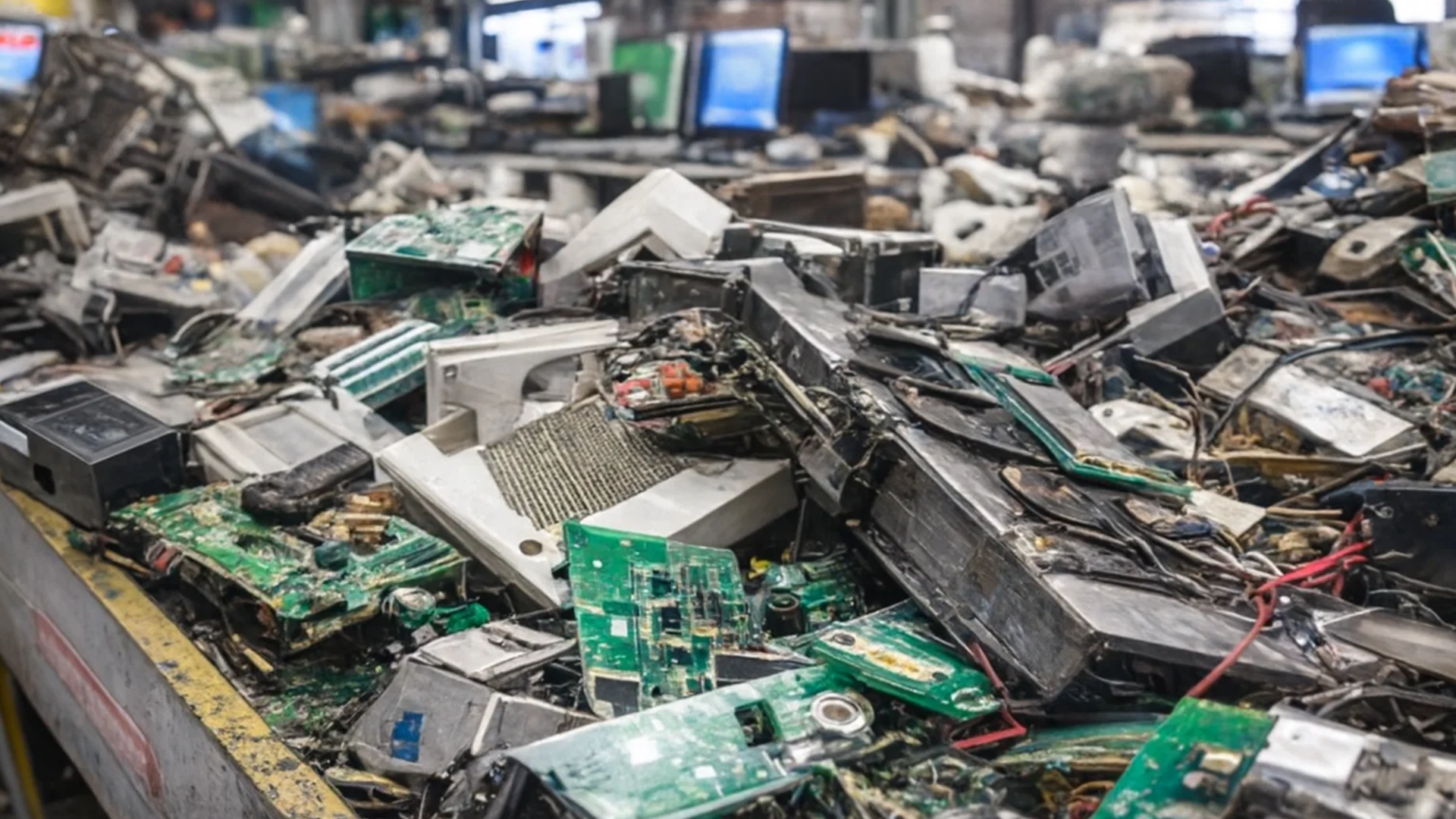
Source: Canva stock images
That does not mean every actor is irresponsible. Many are genuinely trying to balance commercial survival with environmental and legal expectations. But the structure of incentives is clear. If notifying a shipment means extra weeks of waiting, additional documentation, engagement with ministries and multiple authorities, and higher costs, the temptation to take the shortcut is always present.
This is the backdrop against which the Minimise and BlackForest Solutions cooperation in Kenya becomes interesting. It is not just about a shipment. It is about testing whether a different choice can still make sense in this reality.
Rethinking: How Informal Collectors Are Paid?
Most exported e-waste does not start its life in a warehouse. It starts in homes, small repair shops, and informal yards.
In Kenya, as in many other countries, informal collectors often recover value by stripping printed circuit boards out of equipment and discarding the rest. The boards can be sold, the residual shells and screens frequently end up in uncontrolled dumpsites, burned, or left in the environment. This is not because people are careless. It is because they are paid for value, not for environmental outcomes.
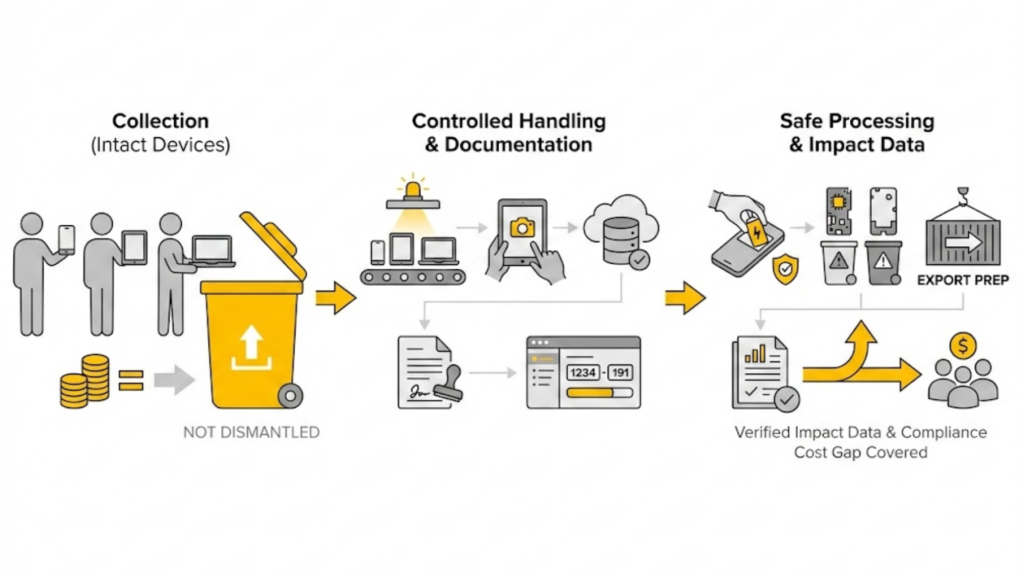
Minimise’s model starts at that point. Instead of asking informal collectors to change behaviour for less money, the company works with partners who are willing to pay the equivalent of the circuit board value under one condition: the devices must remain intact.
Collectors still earn what they would have earned by dismantling, and they do not lose their livelihood. The difference is that the hazardous components stay inside the device until they can be handled in a controlled process. Minimise then documents each step in its software, from collection through sorting and dismantling, using photo based proof criteria that allow remote validation.
Source: BlackForest Solutions Communications
Later, batteries are safely removed and the devices, now correctly classified as waste, are prepared for export to a facility that can treat them under environmentally sound conditions. The financial gap between what the boards would normally cover, and the real cost of compliant handling is covered by selling impact data to customers who want a verified, transparent chain.
It is a small but significant shift. The model recognises the role of informal collectors instead of wishing them away, and channels external contributions to change how value is created.
Why Bother With A Notified Shipment?
If the informal collection side can be addressed in this way, the next question is obvious: why go through the Basel Convention notification process at all, when the system elsewhere often moves without it.
For Minimise’s customers, the answer sits at the intersection of trust, differentiation and long term risk.
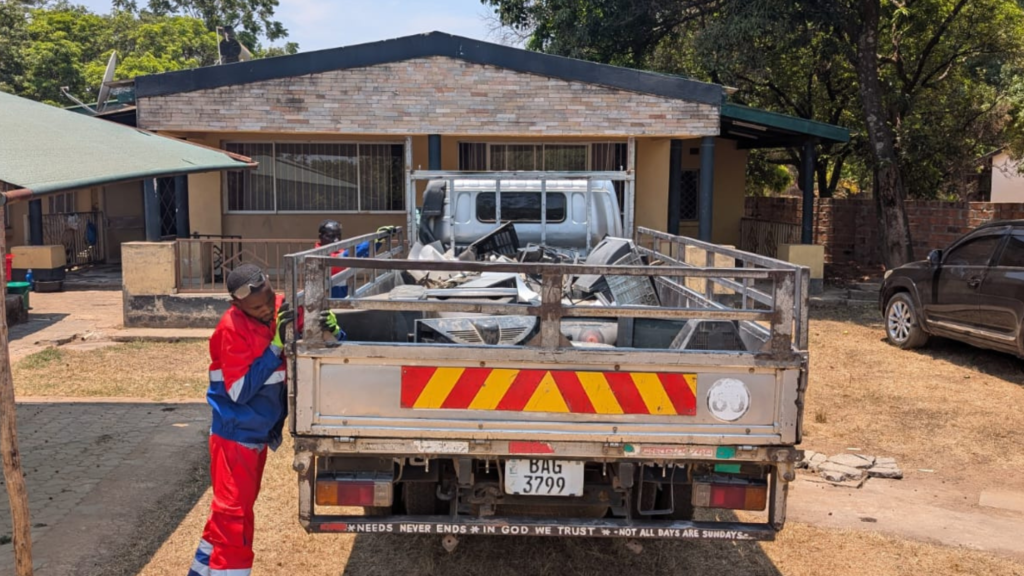
Source: BlackForest Solutions Communications – Kenya E-Waste
Large IT asset disposition firms, recyclers and their corporate clients are increasingly expected to show not only that their partners are certified, but that the cross border movement of material is properly documented. For some, that expectation is driven by environmental and social targets. For others, it is simply about staying ahead of scrutiny and avoiding future headlines.
Minimise’s view is pragmatic. Regulatory and PR risks may not be acute today, especially if bad actors have already been filtered out of the chain, but the direction of travel is clear. The companies that can point to a fully notified and verifiable route from collection in an African market to treatment abroad will be in a stronger position than those who rely on plausible deniability.
For us at BlackForest Solutions, the starting point is different but complementary. Our work sits squarely inside the Basel Convention framework. We specialise in preparing and managing notifications, working with competent authorities in exporting, importing and transit countries to obtain the necessary consents, and coordinating changes and clarifications over the life of a shipment.
Applying that lens to Minimise’s Kenya project meant treating the container as what it is: a transboundary movement of hazardous waste that must be notified.
Building a Legal Pathway From Kenya To The UAE
From a compliance standpoint, the Kenya to UAE route is not a simple commercial lane.
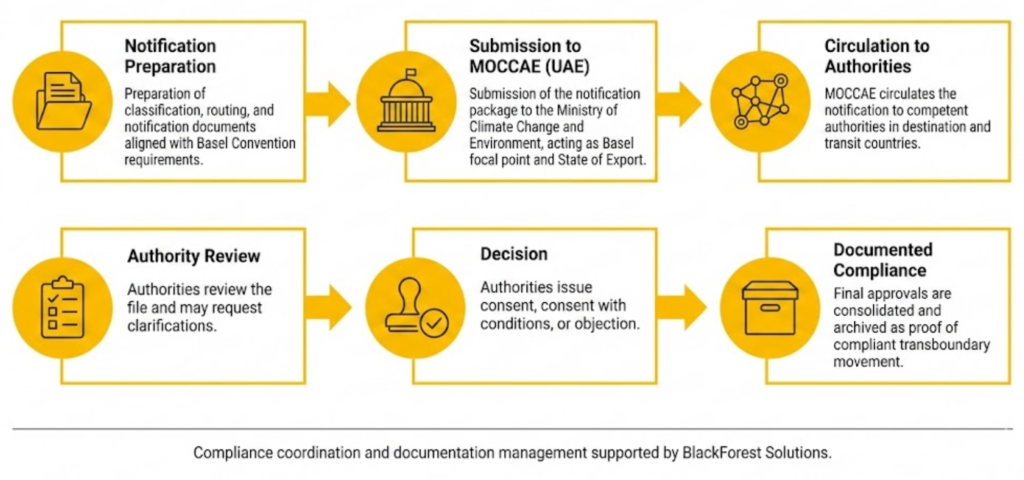
The United Arab Emirates acts as State of Export in this case. The focal point within the Ministry of Climate Change and Environment (MOCCAE) receives the notification package and circulates it to the authorities responsible in the destination country and any transit countries. Each of these authorities reviews the file, may ask for further detail, and issues either consent, consent with conditions, or an objection.
BlackForest Solutions stands in the middle of this process. On behalf of Minimise, the team prepares and submits the full notification package, ensures that classification and documentation are aligned with Basel Convention requirements, responds to questions, coordinates with partners in other countries, and maintains the archive of documents that will later serve as the proof of a compliant movement.
Source: BlackForest Solutions Communications
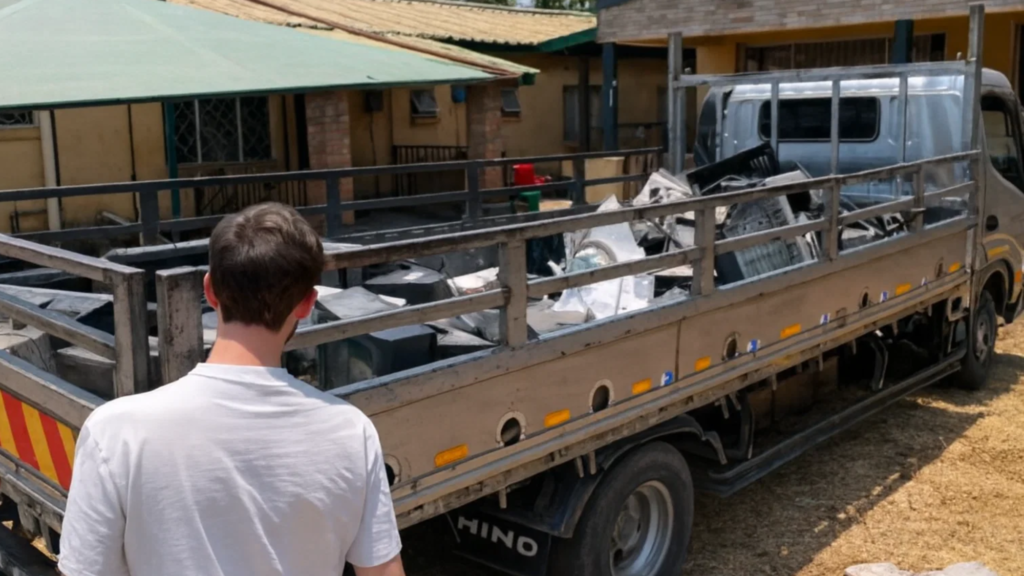
The shipment itself is modest in size: a single twenty foot container filled with end of life IT equipment from households and informal collectors, primarily laptops, tablets and mobile phones. What gives it weight is not volume but the route and the structure behind it.
Movements of this type from African markets do happen, but fully notified and scrutinised shipments are still rare. That is not because they are impossible, but because the time and cost involved often deter actors from attempting them.
The Kenya to UAE project is therefore less a logistical event and more a test case for how a compliant route can be put in place when both a local operator and a specialist compliance partner commit to the longer path.
Spotlight On The Exceptions, Not The Offenders
Recent investigations and media coverage have focused heavily on bad practice in global e-waste flows. That scrutiny is necessary, but it can also create a one sided picture where the only stories that surface are those of failure and malpractice.
The Kenya container offers a different story.
Minimise and BlackForest Solutions are not claiming perfection, and we are cautious not to speak for the whole market. They are, however, choosing a route that most actors would consider inefficient in the short term. We are aligning upstream incentives in a way that respects informal collectors, while still insisting on environmentally sound management. We are going through the full notification route even though competitive pressure might reward faster, less transparent paths.
Highlighting that choice is not about pointing fingers at others. It is about showing that compliance can be made to work when the right pieces are brought together, and that the actors who choose this path should not remain invisible.
Source: BlackForest Solutions Communications – Kenya E-Waste
What This Means for System Builders?
For the wider sector, the signal is simple. As expectations around traceability grow, those who can demonstrate real, documented, cross border compliance will be better placed than those who rely on systems that look clean only from a distance.
The story of this container is not only relevant for Kenya and the UAE. The principles behind it apply wherever e-waste is collected in fragmented ecosystems and exported for treatment.
Subcontractors, IT Assets Disposition (ITAD) firms and recyclers who operate outside Europe but serve global brands sit in a difficult position. They are expected to deliver low cost, high volume services, yet they increasingly face questions about the fate of material that leaves their facilities. Many have partial visibility into export routes at best.
The Minimise and BlackForest Solutions cooperation suggests a different pattern. It brings together three elements that rarely line up in one place:
- field level models that respect informal economies,
- structured compliance expertise for cross border movement, and;
- customers willing to pay for verified impact rather than lowest cost disposal.
None of these elements is new on its own. The innovation lies in the way they are combined and in the choice to go through a notified, documented process even when the short term business case does not demand it.
For system builders in other regions, the practical takeaway is less about copying the exact model and more about asking three questions:
Who is collecting, and how are they paid?
Who is responsible for the legal status of the waste?
Who can design and manage a compliant route that holds up under scrutiny?
From One Container To A Different Kind of Compliance Conversation
At the time of writing this piece, the Kenya to UAE shipment is still in preparation. Devices are being collected, the notification process is in motion, and the first container is expected to move once approvals are in place. Whether the model will scale to larger volumes and more countries will depend on supply, demand and the willingness of customers to back this approach.
What is already clear is that the cooperation is creating a reference point. It shows that fully notified movements of African e-waste to authorised facilities in the Gulf are possible, when partners are willing to invest time and effort. Tdemonstrates a way to align informal collection with environmental outcomes. It gives regulators a concrete, documented case to point to when asked whether compliant pathways exist.
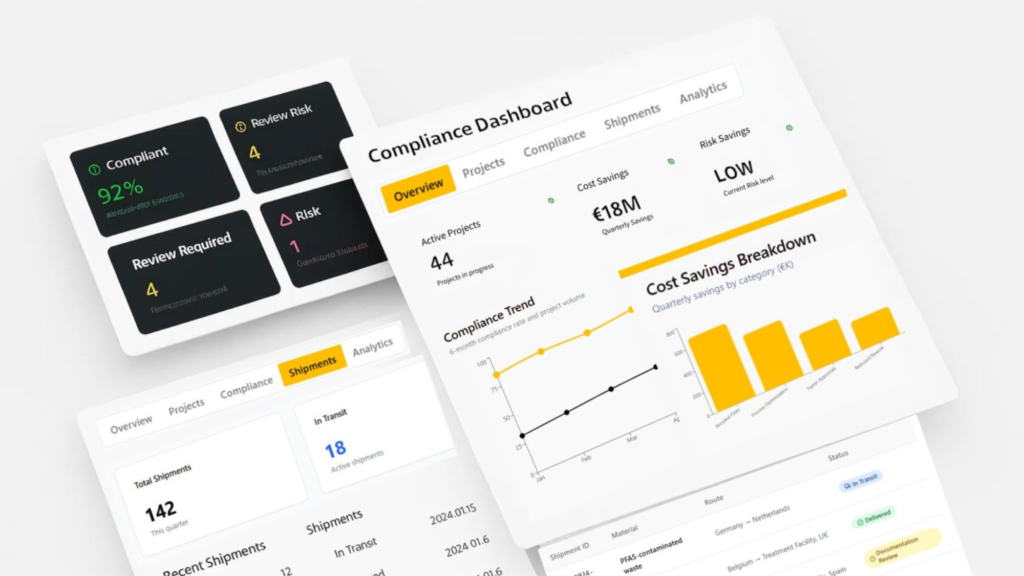
For BlackForest Solutions, this project also connects directly to a broader development. The company is building its Compliance Suite as a set of tools and services designed to make complex waste regulations workable in practice. Including for actors who do not have internal compliance departments.
Source: BlackForest Solutions Communications – Find out more on bfscomplance.com
Experiences from projects like the Minimise cooperation are likely to inform how those tools evolve. Particularly in regions where formal and informal systems overlap.
For Minimise, the shipment is a step in demonstrating that impact claims made in dashboards and reports are tied to verifiable, legally sound flows of material. And not just to collection numbers.
In a sector where the fastest route is often not the most responsible one, a single container moving under full notification rules may not sound revolutionary. Yet it can quietly shift what is considered normal. And sometimes, that is where change begins.
About BlackForest Solutions
BlackForest Solutions is an international environmental services and compliance advisory firm specializing in hazardous and non hazardous waste management, transboundary movements, and regulatory compliance under the Basel Convention.
About Minimise
Minimise is a technology driven company focused on improving the environmental and social outcomes of e waste collection and recycling outside Europe.
FAQs: Basel Convention E-Waste Compliance and Cross-Border Shipments from Africa
Q1. What changed for e-waste exports globally in January 2025?
As of January 1, 2025, all cross-border movements of e-waste — both hazardous and non-hazardous — became subject to the Basel Convention’s Prior Informed Consent (PIC) procedure. Before 2025, only hazardous e-waste required this level of documentation, meaning many shipments moved without formal government approval from importing and transit countries.
Q2. What is the Basel Convention notification process for e-waste exports?
The Basel notification process requires the exporting country to submit a full notification package to the importing and transit countries before any shipment can move. Each authority reviews the file, may request additional detail, and issues consent, conditional consent, or an objection. The exporter must hold approved consent from every country involved before the waste crosses a border.
Q3. Why is compliant e-waste export so rare from African countries?
Full Basel notification involves weeks of waiting, extensive documentation, engagement with multiple ministries and competent authorities, and higher costs than informal routes. In a market where commodity codes can be stretched and the probability of enforcement is low, the financial incentive to take shortcuts is consistently stronger than the incentive to comply — unless customers actively pay for verified impact.
Q4. How does Minimise restructure incentives for informal e-waste collectors in Kenya?
Rather than asking collectors to change behavior for less money, Minimise pays informal collectors the equivalent of what they would earn by stripping and selling circuit boards — on one condition: devices must remain intact. Collectors keep their livelihood, hazardous components stay inside the device until controlled processing, and the whole chain is photo-documented for remote validation.
Q5. What role does BlackForest Solutions play in the Kenya–UAE e-waste shipment?
BFS manages the full Basel Convention compliance process on behalf of Minimise: preparing and submitting the notification package, ensuring classification and documentation meet Basel Convention requirements, coordinating with competent authorities in Kenya, the UAE, and any transit countries, and maintaining the archive of documents that proves the movement was fully compliant.
Q6. What are Y49 and A1181 under the Basel Convention?
Y49 and A1181 are the two new classifications introduced by the 2022 Basel Convention amendments, effective January 2025. A1181 covers hazardous e-waste (containing lead, mercury, or brominated flame retardants), and Y49 covers all other non-hazardous e-waste and scrap. Both categories now require Prior Informed Consent before any transboundary movement — closing the loophole that previously allowed non-hazardous e-waste to trade freely.
Q7. What does this Kenya–UAE project mean for ITAD firms and recyclers operating outside Europe?
ITAD firms and recyclers serving global brands from African or Asian markets increasingly face customer audits asking not just whether their facilities are certified, but whether cross-border movements are properly documented. The BFS–Minimise model shows that a fully notified, verifiable route from an African market to an authorized treatment facility is possible and that the companies building this capability now will be better positioned than those relying on plausible deniability when scrutiny increases.