

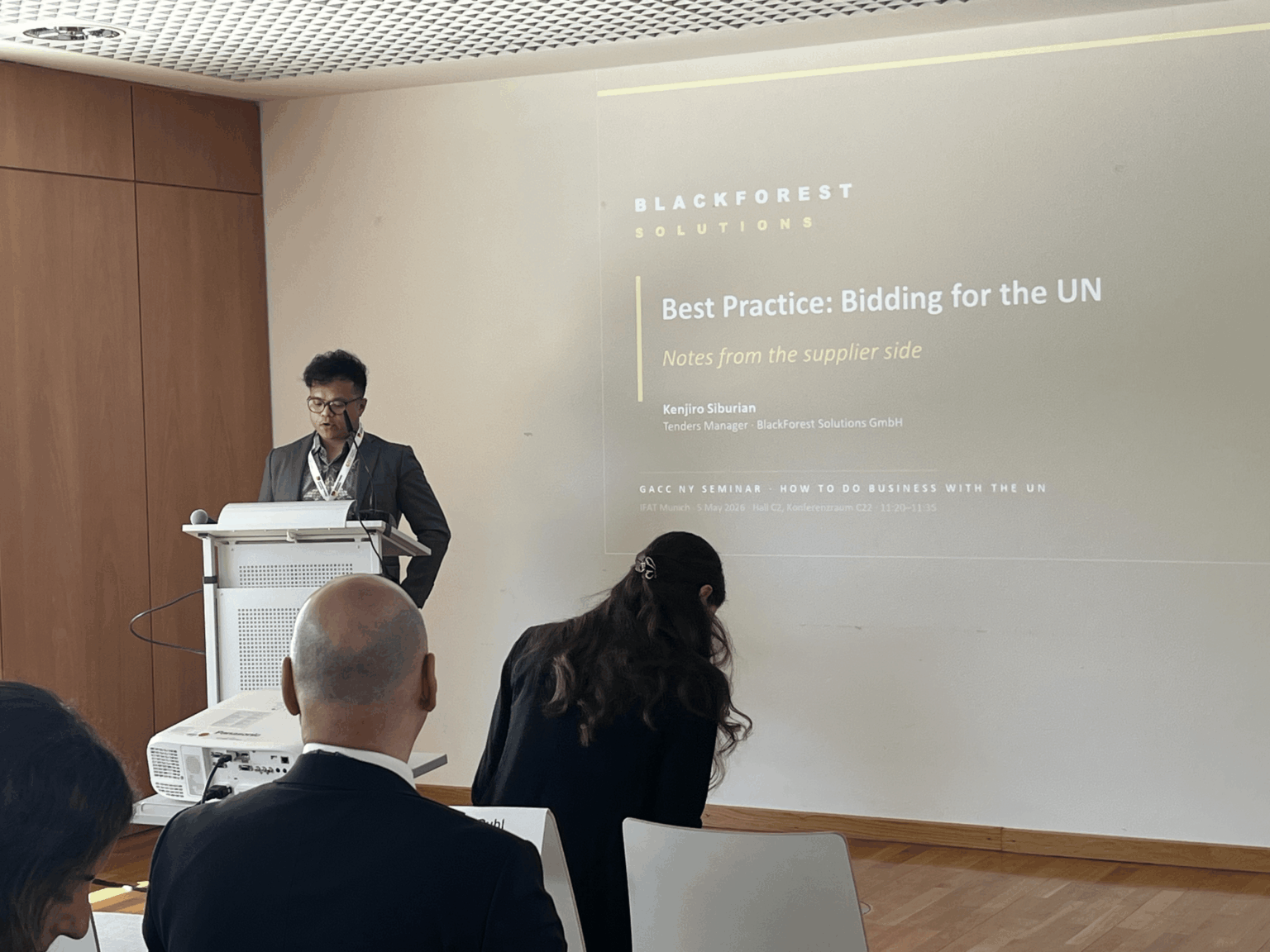
Kenjiro Siburian on the two functions that sit inside every international tender, and what BFS consistently does to successfully collaborate with multilateral organisations.
This is part of our series 10 Years. 10 Lessons where BFS team members share what they actually learned from their hardest projects.
- Responsibility in one line: I find the match between what the international project market is asking for and what BFS can genuinely deliver. Not what we could claim on paper. What we can actually do.
- Every BFS project, in consultancy or in operations, started as a tender on someone’s desk. That is the part people rarely see. The tender desk is where the pipeline begins, feeding both sides of the house: Technical Consultancy and TransFrontier Shipments. It is the backbone of the company. Not the most visible part, but the one that has to hold for everything downstream to stand.
- Waste management does not sit still. The tenders crossing my desk today are not the ones that arrived five years ago. Right now I am watching solar panel waste in Africa move from a footnote to a serious challenge. What counts as expertise keeps shifting, and the desk has to shift with it.
- Every tender is two jobs at once. Market intelligence: reading the opportunity and seeing where it connects to a team strength we already have. Process orientation: knowing what the client’s evaluation criteria actually require, and being honest about whether we meet them. Miss the first and you chase work that was never ours. Miss the second and you write a strong bid that scores zero.
- When a tender asks for something we cannot hold on our own (extra years in a niche, local registration in a specific country), the answer is not to walk away. The answer is to partner. Working with freelancers and company partners to assemble a compliant bid is normal practice, not a fallback.
- Multilateral clients and Official Development Assistance actors are sometimes treated as a separate universe. They are not. They assess bids on clear criteria: in-country experience, topical relevance, and proven work in difficult conditions. From my observation, organisational DNA carries as much weight as technical credentials. Who you are as a company shows up in the score.
- My last lesson is personal, from the move from Indonesia to Germany. Working with a German company taught me to separate two things I used to treat as one: efficiency and effectiveness. Doing the thing right and doing the right thing are not the same. Knowing which one a situation calls for, and when, is its own skill, and I am still sharpening it.What he learned from moving from Indonesia to Germany: Efficiency and effectivity – The two aren’t always the same thing, and knowing when each one matters is a skill in itself.
| 78M tonnes
The volume of end-of-life solar panel waste projected globally by 2050, with the majority generated in regions currently without dedicated solar waste management infrastructure Source: IRENA, The Power to Change, 2016 |
USD 223.8B
Global Official Development Assistance in 2023, with environmental and circular economy projects accounting for a growing share of multilateral procurement Source: OECD DAC, 2024 |
3.4B tonnes
Projected annual waste generation globally by 2050, with the sharpest increases in Sub-Saharan Africa and South Asia – the same regions where end-of-life solar waste will arrive in volume Source: What a Waste 2.0, World Bank |
Kenjiro, you have seen more project briefs than almost anyone else at BFS. What pattern keeps showing up that most people outside the tenders function never see?
Tenders function are understood mostly as paperwork, responding to deadlines, forms/templates, eligibility boxes, etc. From our experience, those are the visible half. The other half is closer to forecasting/strategy.
At its core, my role is finding a match. On one side is the opportunity: a tender from a multilateral, a development bank, or a bilateral agency. On the other side is the team readiness, for example, what BFS knows, where our project experience sits, and what we can genuinely deliver. My responsibility is to connect the two before the gap between them becomes obvious to everyone else.
What our partner rarely sees is how fast that match moves. Waste management does not stand still. Settling on two or three topics and following them indefinitely feels safe. As one of examples, plastic waste is where the attention sits today. The more interesting question is what comes next.
My answer is solar panels. Across Africa and the broader Global South, the panels going up now were largely installed within the same window, which means they will fail within roughly the same window. A decade from now, a continent will face a waste stream it has no infrastructure to handle. From our observation, that is not a problem for later. It is a category in which to start building experience now.
So the work runs on two tracks. The first is reading where opportunities are moving and matching that to what the team can credibly deliver. The second is the discipline of turning a match into a compliant proposal: the deadline, the offer, the eligibility of the project and of every expert we name. One track is judgment. The other is execution. The function only works when both run at once.
You were presenting at “How to Do Business with the UN” at IFAT last week. What do firms like BFS consistently get right when working with multilateral clients, and where does it tend to go wrong?
When working with multilateral clients and Official Development Assistance actors, the firms that do well are the ones that understand their genuine strengths and present them plainly. For BFS, three stand out.
The first is in-country presence backed by relevant experience. Multilateral clients look for demonstrated work in the specific region and on the specific topic of the assignment. If the brief concerns plastic waste in East Africa, what counts is evidence of exactly that, not a general environmental record. From our observation, depth in the right place carries more weight than breadth across many.
The second is the ability to deliver in difficult/special conditions. BFS has worked in remote areas and in post-conflict settings, in places where standard infrastructure is not in place. That kind of operational experience is either visible in a firm’s project references or it is not. It is hard to claim convincingly without having done it.
The third is organisational character. We are an international and relatively young team, and we treat that as a defined quality rather than something to explain away: agility, a range of working languages, and genuine engagement with the Global South as an operating context. Certain clients value this, and recognising which ones do is part of the work itself.
If there is a common pitfall, it is pursuing opportunities where the fit is weak and relying on the writing to close the gap. From my observation, that rarely succeeds. A proposal that genuinely matches the brief will tend to outperform a more polished one that does not.
You came to Germany from Indonesia on a DAAD scholarship, did your master’s at Leibniz University Hannover, and then joined BFS. What was that transition like?
The transition was gradual, and I learned a great deal from it.
In Indonesia, I worked in a context of design, research and problem-solving. That gave me a solid foundation on the technical side. The master’s programme at Leibniz University Hannover built on it. The questions were often the same, but the emphasis shifted: not only what the technical answer is, but how you structure the work to reach it, how you document your decisions, and how you account for your time.
When I joined BFS afterwards, that learning continued. The German professional context places a high value on precision. You work to the deadline. You deliver what you committed to. There is little room for approximation, and I came to appreciate why.
That has shaped how I approach the tenders function. A proposal is a promise. Eligibility requirements are there to be met, not read loosely. A timeline is a commitment, not an opening position. Adapting to that discipline, coming from a different working culture, was something I had to do deliberately. I would not call it easy, but it made me better at the job, and the engineering rigour I brought with me has served me well within it.
What is the one lesson you want readers to take away?
For long years, I have treated efficiency as the goal. Working in a German organisation taught me that it is only half of one.
Efficiency and effectiveness sound like the same idea. They are not, and the gap between them is where most good work quietly disappears. Efficiency is doing a task with the least input necessary. Effectiveness is doing the task that is actually needed to do. A tender can be prepared quickly, cleanly, and on time, and still answer the wrong question. That is the failure no one notices until the result comes back.
The strongest proposals close that gap. They waste no time, and they point that time at the few things that decide the outcome.
The principle reaches well beyond tenders. It shapes how we read an opportunity, how we choose a partner, how we build a team. The question underneath each of them is the same. Speed matters less than direction. Are we doing the thing that actually needs doing? Answer that first. Then do it well. That is the lesson I keep returning to..
Key Takeaways; Kenjiro Siburian on International Tenders and Multilateral Procurement
- Winning a tender is two jobs at once, and most teams are only fluent in one. Market intelligence tells you where the work is moving and whether you can honestly do it. Process discipline turns that into a bid that survives every eligibility check. Skip either and the other is wasted.
- Multilateral clients don’t buy promises they buy proof. Three kinds: that you’ve done this exact thing in this region, that you’ve delivered when conditions were hard, and that how you work matches what they care about.
- The biggest waste opportunities are the ones nobody can handle yet. Solar panels, batteries, e-waste, end-of-life vehicles – streams piling up in places with no system to process them. Whoever reads that curve early gets there first.
- An eligibility gap is a reason to find a partner, not a reason to walk away. But evaluators can smell a paper partnership. If a partner’s name is on the bid, their hands have to be on the work.
- Efficiency gets you a fast proposal. Effectiveness gets you the right one. They feel similar under deadline pressure, which is exactly when teams confuse them.
“Working with a German company needs you to work efficiently and effectively. Those are two different things.”
Kenjiro Siburian, Tenders Manager, BlackForest Solutions
About the series: BlackForest Solutions turns 10 in 2026. Instead of a celebration, we asked 10 team members to share the hardest lesson from their hardest project. This is what a decade of doing the work actually looks like.
About Kenjiro Siburian: Kenjiro Siburian is the Tenders Manager at BlackForest Solutions GmbH. He holds an MSc in Water Resources and Environmental Management from Leibniz Universität Hannover, which he completed on a DAAD (German Academic Exchange Service) scholarship. His earlier background is in chemical and process engineering, with research experience in energy systems and algae bioprocessing in Indonesia. Before BFS he worked at Medco E&P Indonesia. He joined BFS directly after completing his master’s programme and has been part of the team for several years. He was a panelist at the World Bank-financed procurement roundtable at IFAT Munich 2026, alongside BFS Technical Director Rafaela Craizer. He is responsible for international tenders and project development at BFS.
Key Concepts
Market intelligence (tenders context): The ongoing process of scanning the international project market to understand which opportunities are emerging, which are declining, and where they align with a firm’s actual capabilities. For BFS, this includes identifying upcoming waste streams — such as solar panel waste in Africa — before they become mainstream tender categories.
Process orientation: The technical and administrative discipline of building a compliant proposal: meeting all eligibility requirements, structuring the bid correctly for the evaluation criteria, and delivering within the timeline. In competitive international tenders, process failures eliminate strong technical proposals before evaluation begins.
Official Development Assistance (ODA): Grants and concessional loans from governments and multilateral institutions to developing countries for economic development and welfare programmes. The OECD tracks global ODA flows, which reached USD 223.8 billion in 2023. Environmental and waste management projects represent a growing category within multilateral ODA procurement.
Multilateral client: An international organisation funded by multiple member countries, such as the World Bank, United Nations agencies, the Asian Development Bank, or regional development banks. Multilateral procurement processes follow specific eligibility and evaluation frameworks that differ significantly from bilateral or private sector contracting.
DAAD: The Deutscher Akademischer Austauschdienst (German Academic Exchange Service), the world’s largest funding organisation for the international exchange of students and researchers. DAAD scholarships bring international students to German universities for master’s and doctoral programmes, and have been an entry point for many of the people who now work in Germany’s environmental sector.
Solar panel end-of-life waste: Photovoltaic panels have a productive life of approximately 25-30 years. The rapid expansion of solar installation in the 2000s and 2010s means a large volume of panels will reach end-of-life simultaneously over the next decade. IRENA projects 78 million tonnes of solar panel waste by 2050, with a significant share in regions – including Sub-Saharan Africa – that currently have no established solar panel waste management infrastructure.
FAQs: International Tenders, Multilateral Procurement, and Waste Sector Market Intelligence
Q1. What does a tenders manager actually do in an environmental consultancy?
A tenders manager identifies and evaluates opportunities published by multilateral organisations, development banks, and bilateral agencies, then manages the preparation of compliant bids. The role involves two parallel functions: market intelligence (matching the opportunity landscape to the firm’s genuine capabilities) and process orientation (building proposals that meet eligibility requirements, technical specifications, and deadlines). Day-to-day, the weight of the work lies in managing the gap between what the ToR demands and what we can demonstrate, with the hardest skill being the accurate interpretation of the evaluation grid before a single word is drafted. This also involves strategic partnerships: they are a deliberate first move on most multilateral bids, not a fallback, ensuring the firm can meet complex eligibility criteria through genuine collaboration.
Q2. What do multilateral clients like the World Bank or UN agencies look for in environmental service providers?
Three criteria appear consistently in multilateral evaluation. First, demonstrated in-country or in-region experience that is directly relevant to the assignment topic: assessors check whether the reference geography and the waste stream actually match the assignment. Second, evidence of work in difficult operational conditions – remote areas, post-conflict settings, infrastructure-limited environments – that demonstrates the firm can actually deliver. Third, organisational qualities that match the client’s priorities, including an international team with genuine Global South operational depth. Crucially, reference recency matters; many ToRs cap eligible references to the last five or ten years, meaning even strong projects are ineligible if they fall outside that window.
Q4. How do environmental consultancies work with multilateral procurement when they do not meet all eligibility requirements?
Partnerships are the standard response to complex eligibility requirements. However, evaluators look for genuine involvement rather than nominal partnerships: they check for a partner’s actual person-days and named roles in the workplan, not just a logo on a cover page. The cleanest approach is to match the partner’s contribution directly to the specific project reference they are contributing to the bid. This ensures that the expertise being used to meet eligibility is the same expertise being applied to the project delivery, a detail that survives rigorous procurement scrutiny.
Q5. What is the DAAD and how does it connect to BFS’s team?
The DAAD (Deutscher Akademischer Austauschdienst) pathway provides a specific professional and technical advantage for BFS. It allows the firm to field experts and engineers who have actually lived and worked for extended periods in the regions where the projects are based. This regional expertise and operational history is a verifiable technical credential that clients can confirm via expert CVs, providing the demonstrated in-country experience often required in international tender evaluations.
Q6. What is the difference between efficiency and effectiveness in the context of international development work?
Efficiency and effectiveness are distinct disciplines in international development. Efficiency is completing a task with minimum input, but an efficiently prepared bid that misreads the evaluation grid is a wasted bid. Effectiveness is about doing the right task to address the requirement. In the context of international tenders, effectiveness starts with a rigorous interpretation of the evaluation grid before drafting begins. This professional discipline ensures that the effort level is directed toward the specific criteria that decide the outcome, rather than simply completing the administrative process quickly.
Q7. How is BFS positioned differently from larger environmental consultancies in multilateral procurement?
Three differentiators consistently define BFS’s competitive position. First, operational depth in the Global South: BFS has delivered projects in more than 100 countries, including delivery in difficult operational conditions such as hazardous waste shipments from post-conflict regions. This volume of experience carries more weight when attached to such concrete proof of delivery. Second, a specialist concentration in waste management, hazardous waste, EPR, and circular economy. Third, an international and agile team with genuine operational engagement in the regions where multilateral clients are deploying programmes. These internal qualities allow the firm to meet the specific technical and geographic requirements of complex international tenders.