

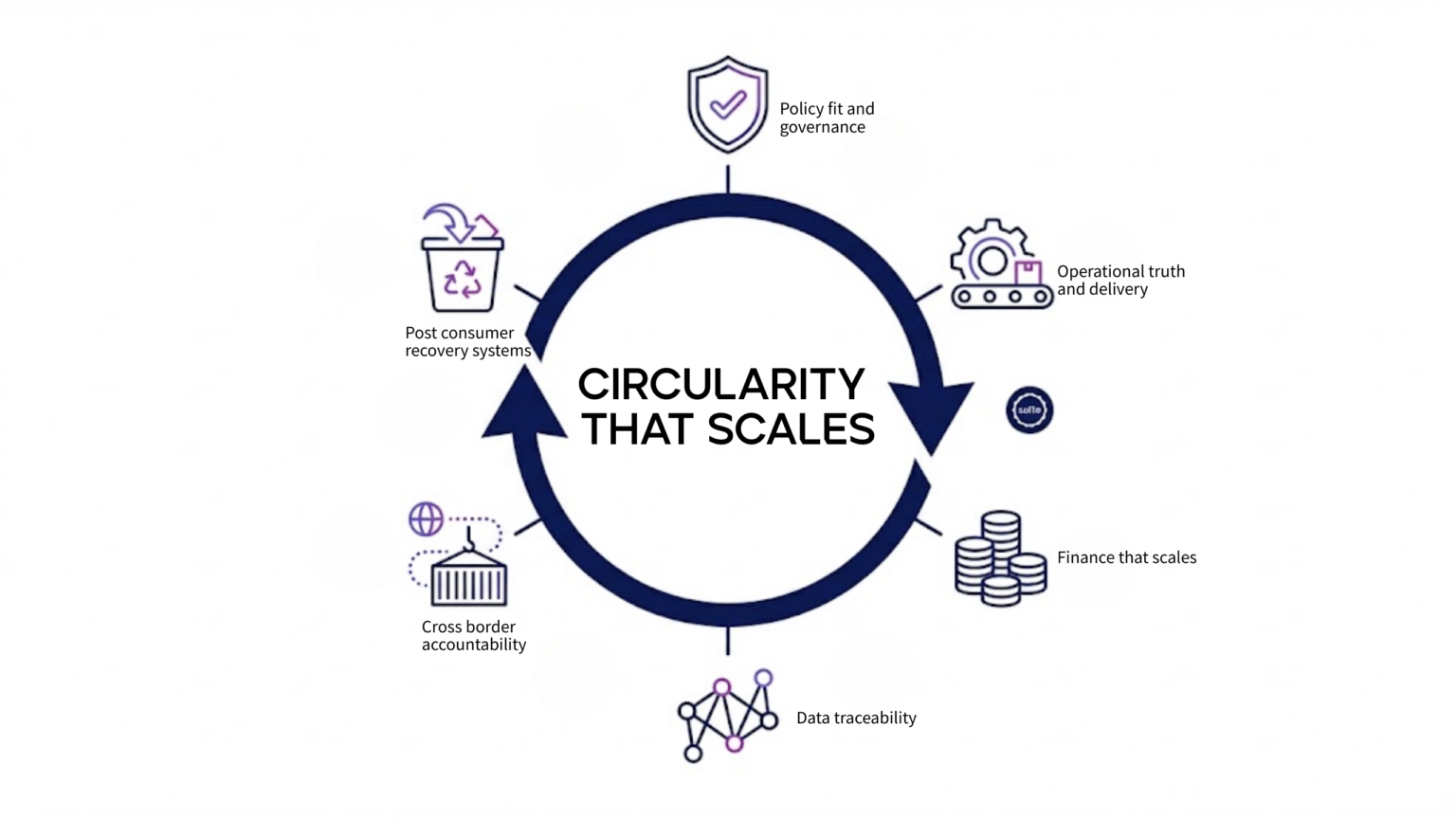
The circular economy is entering a new phase. The era of broad commitments and aspirational targets is giving way to something more demanding, proof.
That shift is not a branding issue. It is a systems issue. Circularity becomes real only when it can withstand three forms of pressure: regulatory scrutiny, operational reality, and financial durability.
When any one of these collapses, the system collapses with it.
- Circular economy ambitions are increasingly tested against three hard criteria: policy fit, operational truth, and financial durability – not goodwill, aspiration, or pilot momentum.
- Pilots that fail to answer all three questions become fragile systems. Fragile systems do not scale – they become a series of short-lived interventions that consume resources without producing durable change.
- Policy fit means operating within the regulatory framework without constant exceptions. Operational truth means designing for how collection, sorting, and recovery actually work on the ground. Financial durability means the economics survive multi-year delivery cycles.
- RainbowForest Solutions connects these three realities through BFS (compliance), GFS (EPR and post-consumer recovery), TFS (cross-border traceability), and the BFS Compliance Suite (audit-ready reporting).
| 3
Non-negotiable conditions for a circularity venture to survive scrutiny and scale operationally Policy Fit · Operational Truth · Financial Durability |
#1
Reason circular pilots stall: system design gaps – not ambition failures or technology limitations |
EPR+ Cross-border flows, post-consumer recovery & hazardous waste all require audit-grade data layers to scale Source: BFS / GFS / TFS Practice Areas |
The Common Failure Pattern, Why Pilots Do Not Scale
Many circular initiatives start with strong intent and early momentum. Then they stall. Not because the problem is too big, but because the system design skipped a hard question.
That real world has constraints: segregation and contamination rates, informal sector dynamics, uneven infrastructure, changing enforcement, cross border movement rules, procurement timelines, and data requirements that grow sharper every year.
If the initiative cannot produce credible chain of custody, defendable reporting, and stable operational performance, it becomes fragile. And fragile systems do not scale.

The Three Conditions That Decide Whether Circularity Becomes A System
1) Policy Fit
Policy fit is simple, it means the solution aligns with the local regulatory environment and can operate inside it without constant exceptions.
This includes:
clear obligations (for example, EPR roles and responsibilities), enforceability, and reporting structures that match what authorities and stakeholders will actually demand.

When policy fit is missing, the initiative depends on goodwill. Goodwill is not a governance model.
Check what we are doing at RFS
2) Operational Truth
Operational truth means designing for what is true on the ground, not what is convenient in a strategy deck.
In practice, this includes:
collection and sorting realities, recovery pathways, contamination risks, chain of custody processes, and the human workflow that moves material from households to recovery.
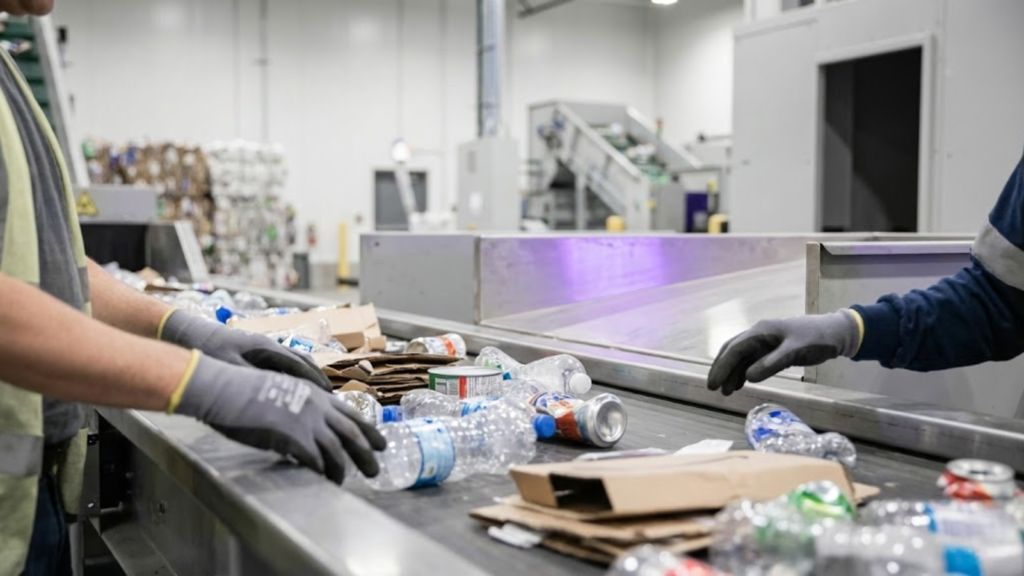
This is also where the difference between a circular claim and a circular system becomes visible.
See what we are doing with GreenForest Solutions (post consumer systems with partners, EPR, recovery pathways, traceability)
See solutions from BlackForest Solutions (technical operations, compliance depth)
3) Finance That Can Scale
Circularity is often framed as a technical challenge, but many failures are financial design failures.
A scalable system needs:
a model that can survive audits, procurement cycles, and multi year delivery, including incentives that keep performance stable when attention moves on.

If the economics are not stable, the system becomes a series of short lived interventions.
Where RFS Fits, Connecting What Is Usually Fragmented
RainbowForest Solutions exists to connect these realities into a single implementation pathway, so environmental ambition can become operational capability.
Within the group:
BlackForest Solutions (BFS) supports compliance and technical operations, including hazardous waste governance where failure has consequences.
TransFrontier Shipments (TFS) supports cross border movement accountability, where documentation, controls, and traceability are non negotiable.
GreenForest Solutions (GFS) supports post consumer circular systems with partners, including EPR design, stakeholder alignment, recovery pathways, and data driven traceability in emerging market contexts.
And the BFS Compliance Suite supports audit ready documentation and reporting, so systems can prove performance, not just describe it.

The Practical Takeaway, Three Questions To Ask Before You Scale
If you are building an EPR program, a post consumer recovery pathway, or a hazardous waste governance upgrade, ask:
- What must we be able to prove, and to whom (regulator, customer, investor, public)?
- What will break first operationally, and what controls prevent that failure?
- What financial mechanism keeps performance stable after the pilot spotlight fades?

If you cannot answer these, the problem is not your ambition. It is your system architecture.
So How Should You Survive?
Circularity that survives scrutiny is not louder, it is tighter. Clear governance, operational truth, and audit grade data.
If you are working on circularity, EPR, hazardous waste accountability, or cross border material flows, and you want to build something that can scale without collapsing under scrutiny, RainbowForest Solutions can help you connect the pieces into a system.
Reach out to us by answering these three questions in the above section via our contact form and we will get back to you at the earliest.
Frequently Asked Questions: Scaling Circular Economy Ventures
Q1. Why do most circular economy pilots fail to scale?
Pilots typically stall because the system design avoids hard questions around regulatory fit, operational ground-truth, and financial durability — meaning good intent meets poor architecture when real-world constraints hit.
Q2. What is “policy fit” in the context of circular economy ventures?
Policy fit means the solution operates within the existing regulatory framework — clear EPR role assignments, enforceable reporting structures — without relying on exemptions or unofficial goodwill to function day-to-day.
Q3. What does “operational truth” mean for a circular economy system?
It means designing for how collection, sorting, contamination management, and material recovery actually work on the ground — not the idealized version in a pitch deck — including informal-sector dynamics and uneven infrastructure realities.
Q4. How should a circular venture structure its financial model to survive scale?
The financial model must survive audit cycles, multi-year delivery timelines, and shifting stakeholder attention — with built-in performance incentives that keep the system functioning even after the pilot spotlight fades.
Q5. What does audit-grade data mean for circular economy reporting?
It means verifiable, chain-of-custody documentation of material flows that satisfies regulators, procurement teams, and investors simultaneously — moving beyond narrative claims to evidence that can withstand independent review.
Q6. How do cross-border material flows complicate circular economy compliance?
Transboundary waste movements require specific documentation controls under frameworks like the Basel Convention — where missing traceability records expose both exporters and importers to legal liability and regulatory sanctions.
Q7. How does RainbowForest Solutions help scale circular economy ventures?
RFS connects policy alignment, operational design, and financial structuring into a single implementation pathway — via BFS (compliance), GFS (EPR and post-consumer recovery), TFS (cross-border traceability), and the BFS Compliance Suite (audit-ready reporting).